Analia Saban - Data Center
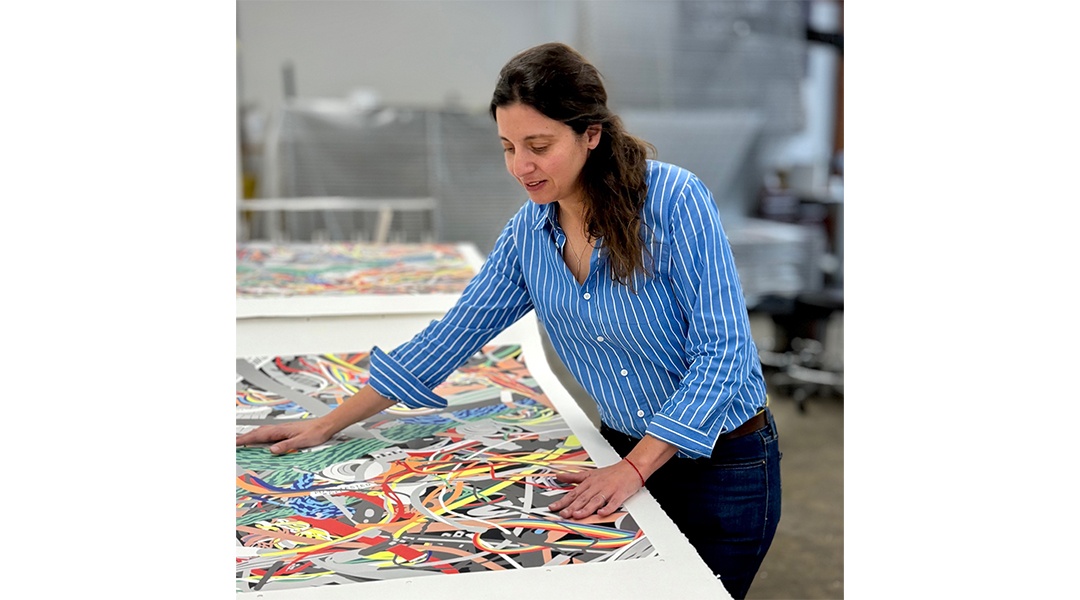
Analia Saban in the lithography studio at Gemini looking at proofs of E-Trash. Photo © 2026 Suzanne Felsen
We live in a moment when everything is quantifiable — or at least, everything is being made to seem so. Our social lives, our finances, our attention, our time: all of it flowing through data centers we never see, stored in servers that run hot and require vast cooling systems just to keep functioning. Data Center takes that condition as its subject, and asks what it means to make something physical, handmade, and natural out of the infrastructure of the digital world.
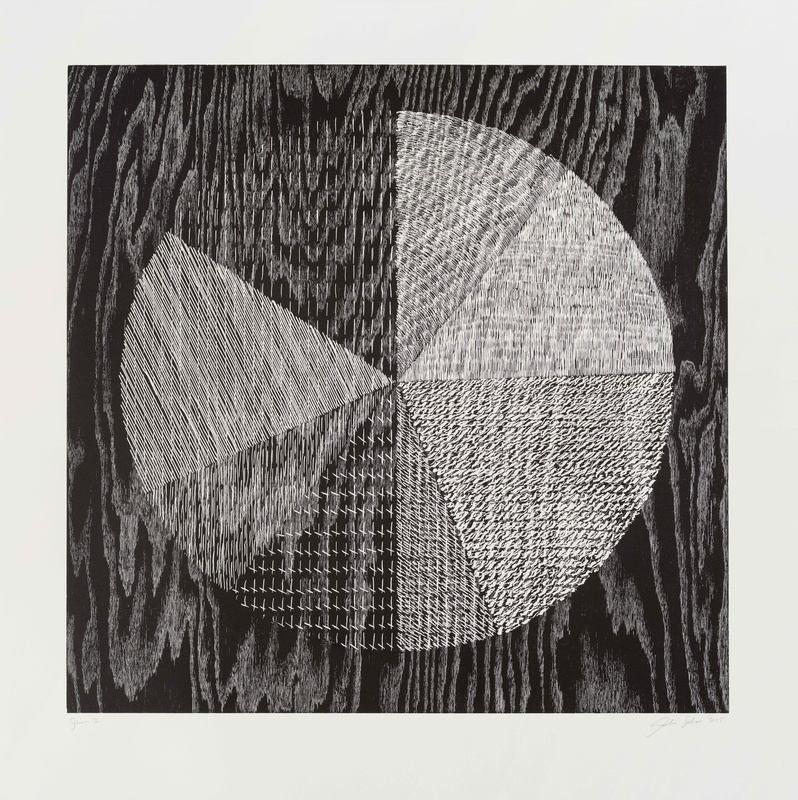
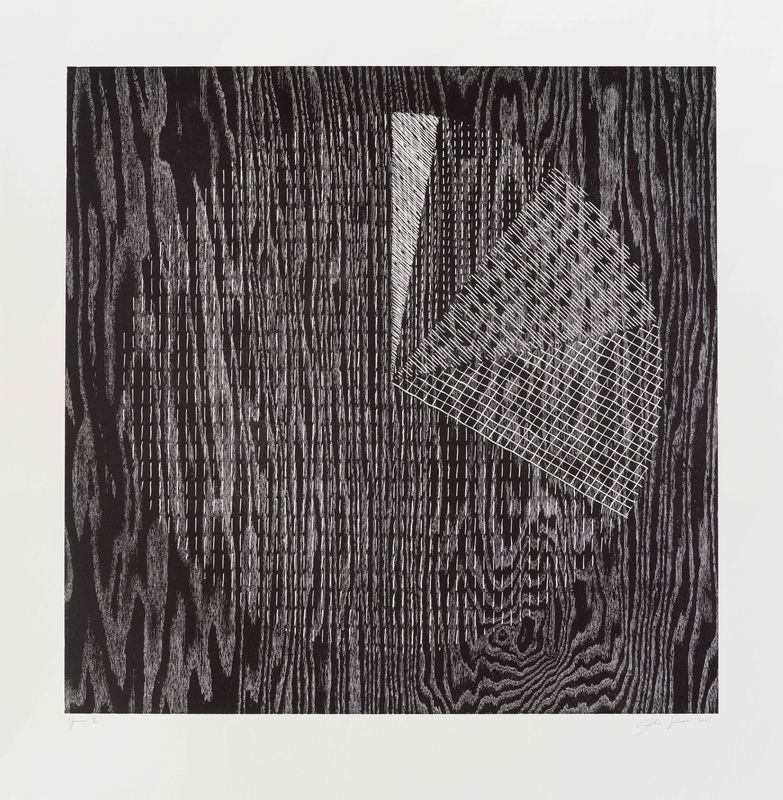
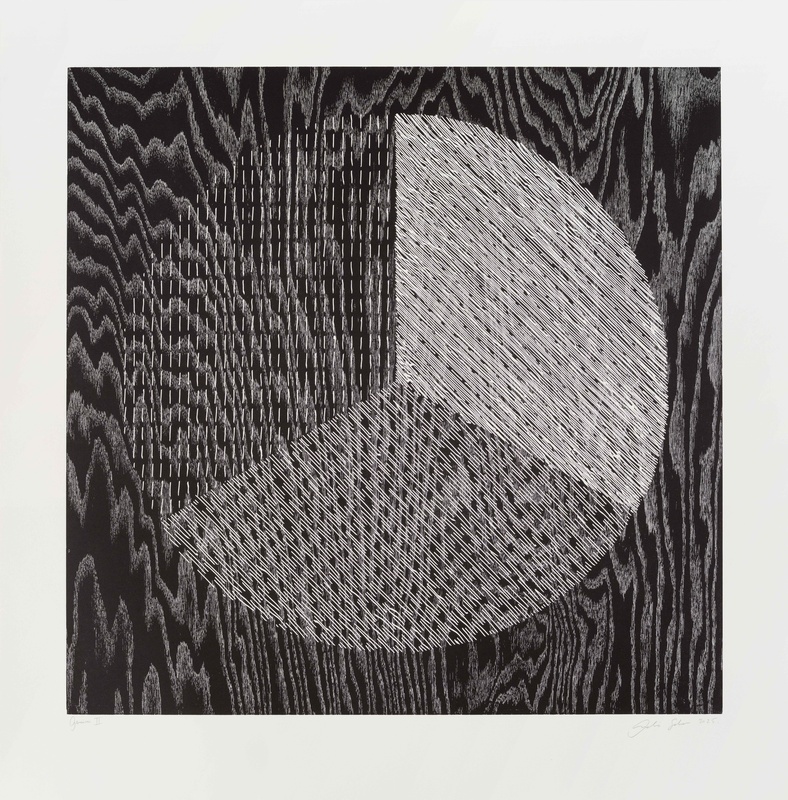
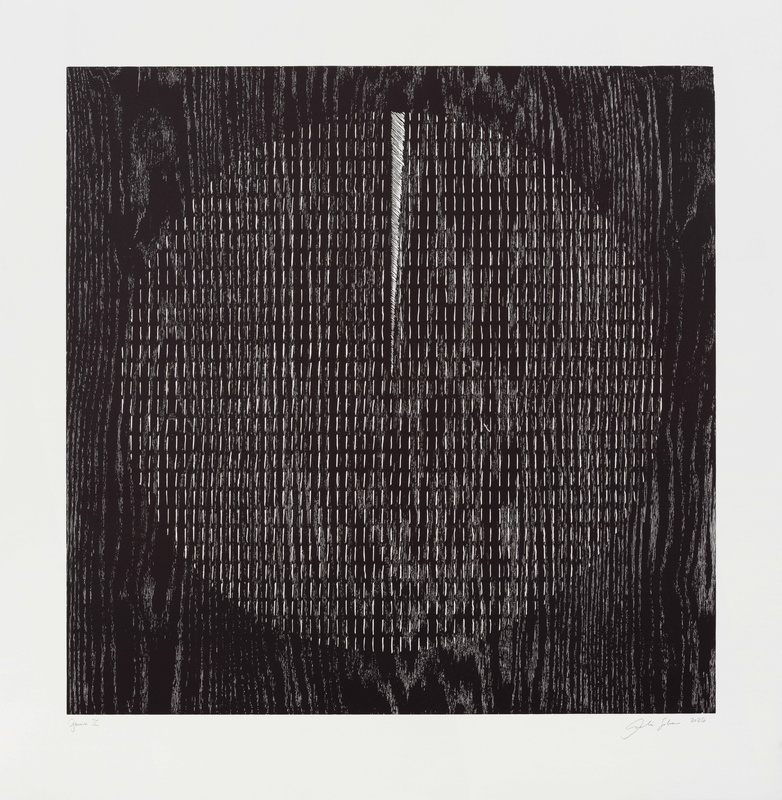
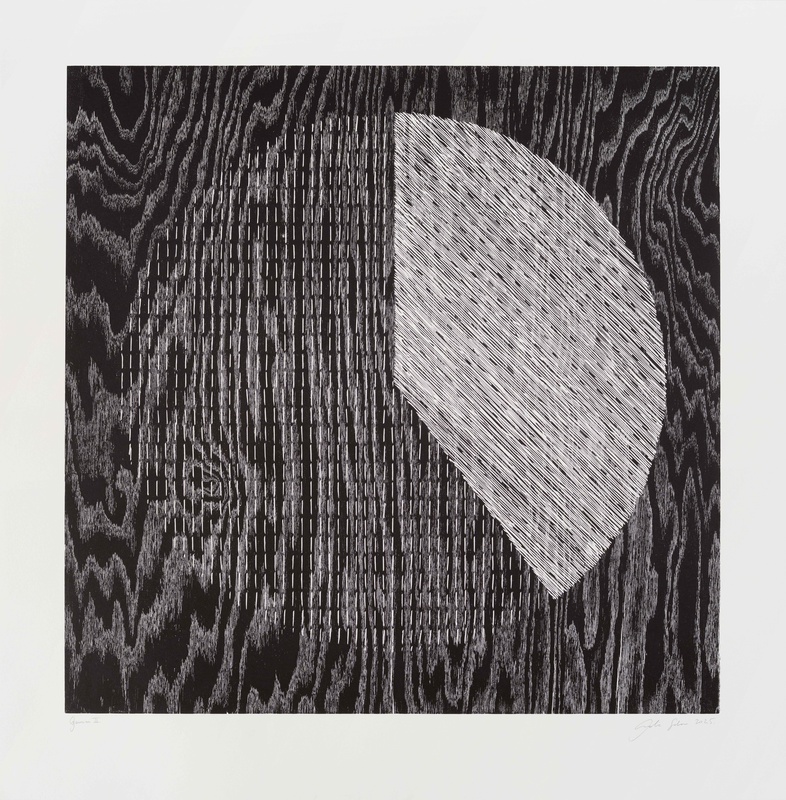
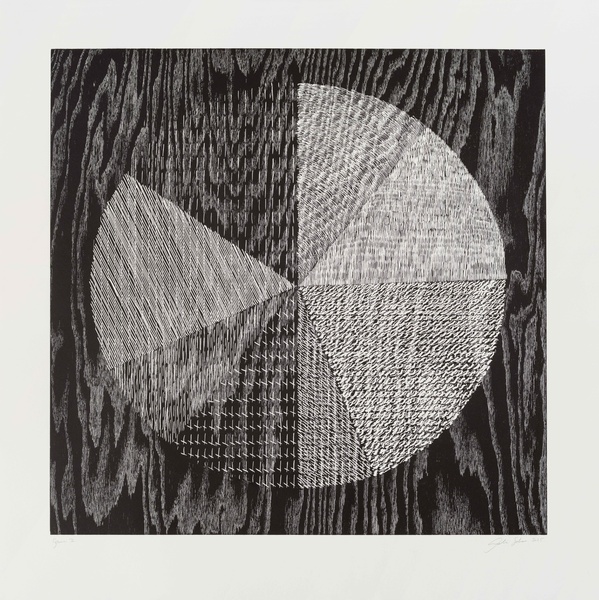
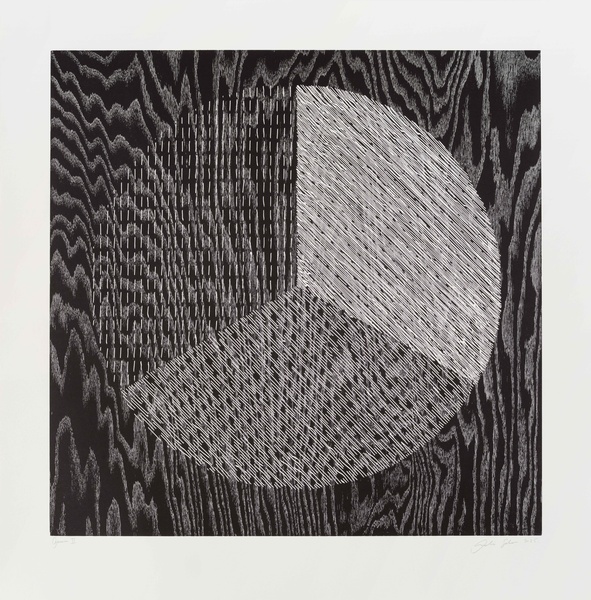
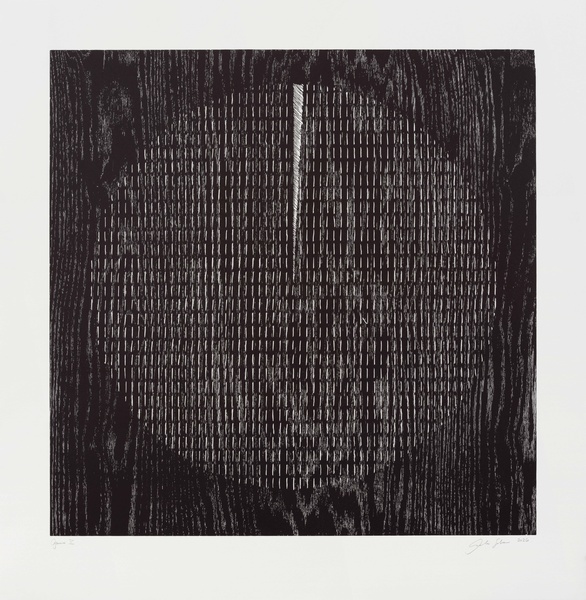
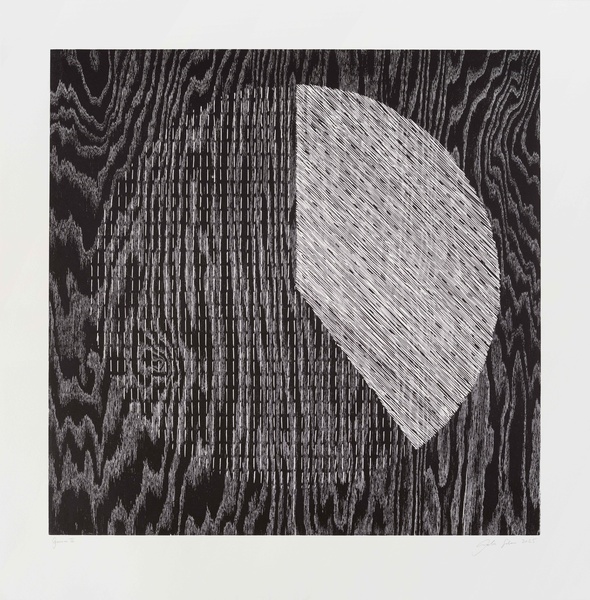
The Pie Chart series begins with a formal provocation. Woodcut is one of the oldest printmaking processes, rooted in the grain and resistance of natural material. The pie chart is among the most familiar tools of data visualization — a diagram designed to make information legible at a glance, to reduce complexity to clean proportion. Saban brings them together deliberately. The beauty of the wood grain is not incidental; it is the point. The organic surface pushes back against the rational diagram, absorbing it, complicating it, making it feel ancient rather than analytical. Two opposites — the digital and the natural — held in the same image.
The titles carry their own quiet wit. Pie Chart (11%, 14%, 19%, 6%, 11%, 7%, 16%, 16%) promises exactitude — eight segments, perfectly totaling 100% — yet no legend is provided, no context given. The structure of data remains, but its meaning is withheld. Pie Chart (3%, 8%, 11%, 11%, 67%) tips into imbalance, one segment consuming the composition while the others are reduced to slivers. Pie Chart (40%, 60%) strips the form to its simplest terms: two masses, a majority and a minority, reading almost like landscape.
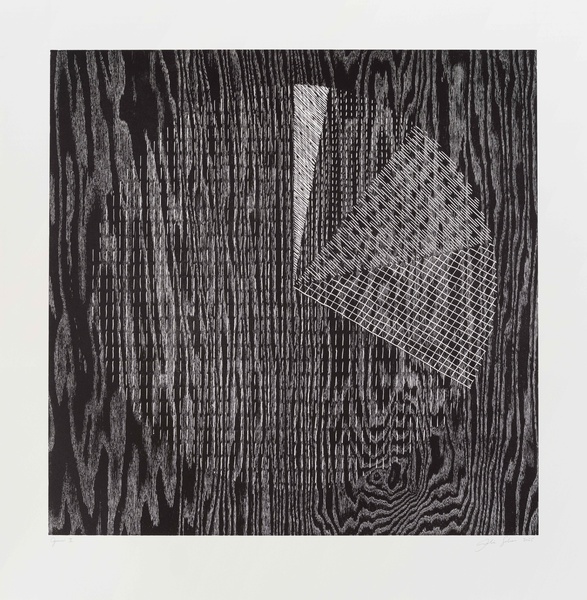
Pie Chart (33.3%, 33.3%, 33.3%) proposes perfect equality — and then quietly fails to achieve it. Three times 33.3% reaches only 99.9%. The system almost closes, but never fully does. And Pie Chart (1%, 99%) takes that logic to its limit: a vast field of dark woodgrain with the thinnest sliver of light at the edge. The diagram is technically complete, but one segment has all but vanished. The data is present; the meaning is not. These are works about the things that cannot truly be quantified — emotion, experience, connection — forced into a form that insists on quantifying everything. The geometry of the circle, the triangle, the line carries an emotional charge that the diagram was never designed to hold.
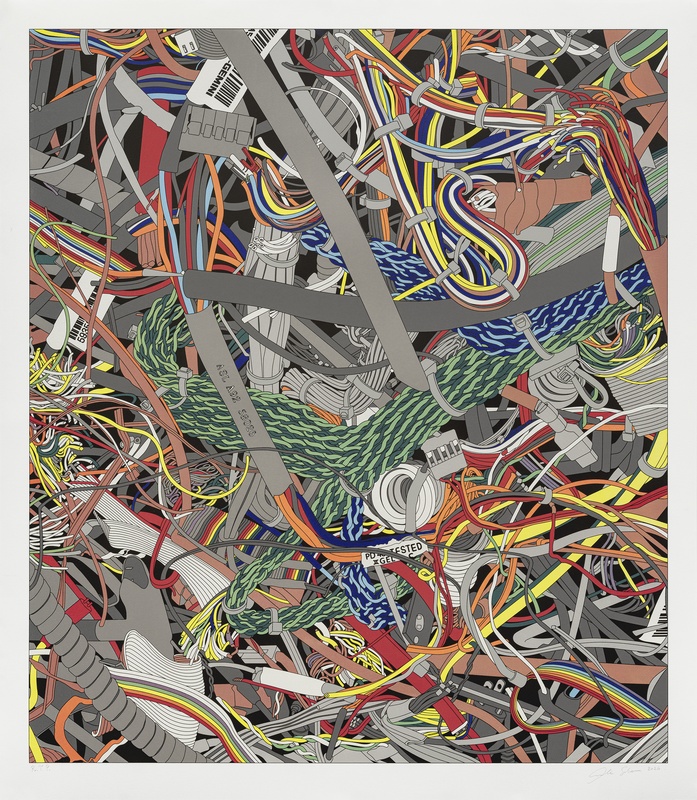
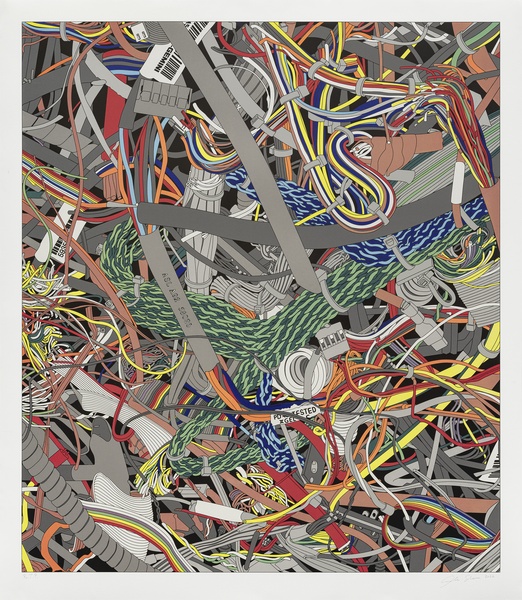
E-Trash completes the picture in full color — the only work in the exhibition to break from the black-and-white vocabulary of the woodcuts. The cables are the junk, the overflow, the physical residue of digital life. Every email, every stored file, every transaction involves an enormous amount of unseen material labor and physical infrastructure. Saban renders that tangle as something almost painterly, even ecstatic — connecting it to the energy of Abstract Expressionism, the allover field, the sense of total immersion. What part of your life, the work seems to ask, is the computer? What part of your interior life has passed through a cable, a server, a data center?
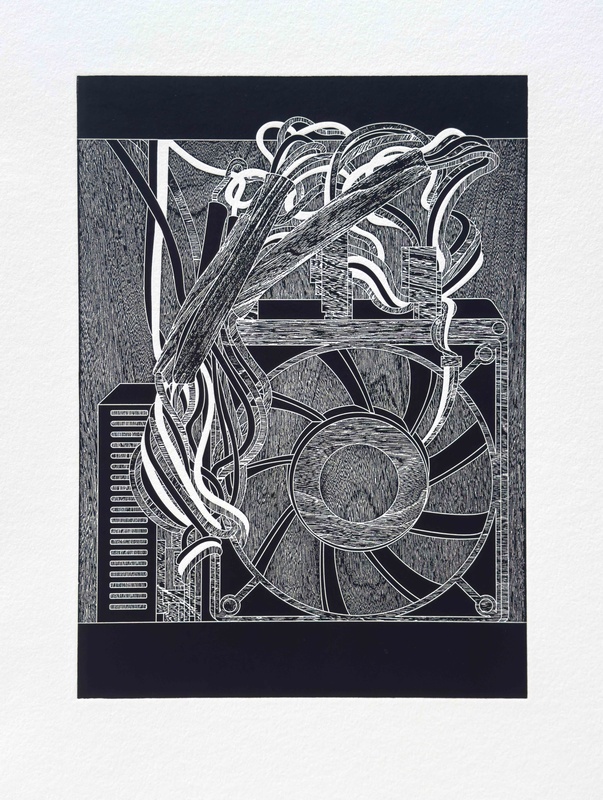
Computer Fan (Woodcut) extends the series into more urgent territory. Data centers generate enormous heat. The cooling systems required to keep them running — fans, ventilation, temperature regulation on a massive scale — are among the least visible and most consequential infrastructures of contemporary life. Saban renders the computer fan in black and white woodcut, printed with oil-based inks: a natural medium for a machine component. The result is unexpectedly monumental. What is ordinarily disposable, invisible, purely functional acquires a strange weight. The warming of the planet and the cooling of the machine are part of the same system.
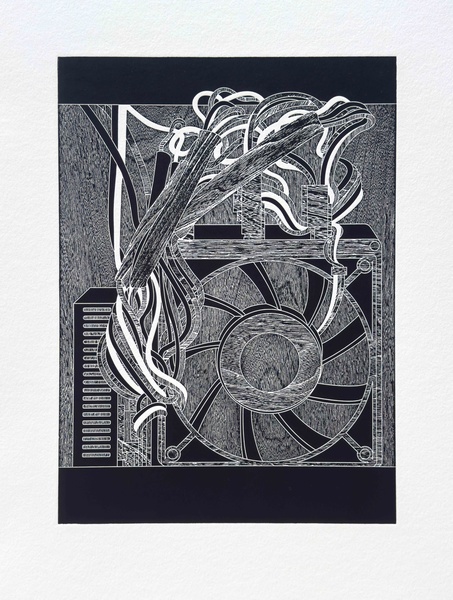
For this exhibition at Gemini, Saban has chosen to show the full edition of Computer Fan (Woodcut) — all 30 impressions together. It is a decision that honors the labor of the printers, making visible the process and the people behind it, the physical act of combining hand and machine that printmaking has always been. To see the full edition is to understand that each impression is both identical and singular, that repetition and uniqueness are not opposites. It is also, in its own way, a form of connection — between the artist and the printer, between the viewer and the work, between the handmade and the quantified world we now inhabit.
Workshop Notes
Print projects almost always begin as a conversation between the artist and the printers. The discussion with Analia pertaining to her Pie Chart series transpired over a period of several months where we contemplated and tested woodblocks and the different grains they had to offer. She decided on oak and felt it provided a grain that could intertwine with the woodcut marks she would make. Five heavy paper stencils were laser-cut with each of the images. Marks transferred from the stencils to the blocks provided a “map” for Analia to make her cuts. She tested several tools to carve the blocks, and chose a Dremel tool to cut marks angled at different degrees and consisting of different lengths. We briefly contemplated color but decided black better allows the viewer to study the skillful marks weaving in and out of the woodgrain.
E-Trash is Analia’s first color lithograph made with Gemini. Printed from 14 aluminum plates, the image consists of 13 colors, and we used the very largest 2-person roller in studio. In working with Analia on this image, we experienced how much she welcomes chance happenings and the unexpected. She invited us, the printers, to introduce colors beyond the version she initially presented, looking forward to what would transpire. During the process of proofing, we added one color each day to the print, similar to painting in layers, ultimately resulting in a final vibrant and pleasing tangle of shapes and colors.
Jill Lerner
Master Printer & Manager, Lithography Studio
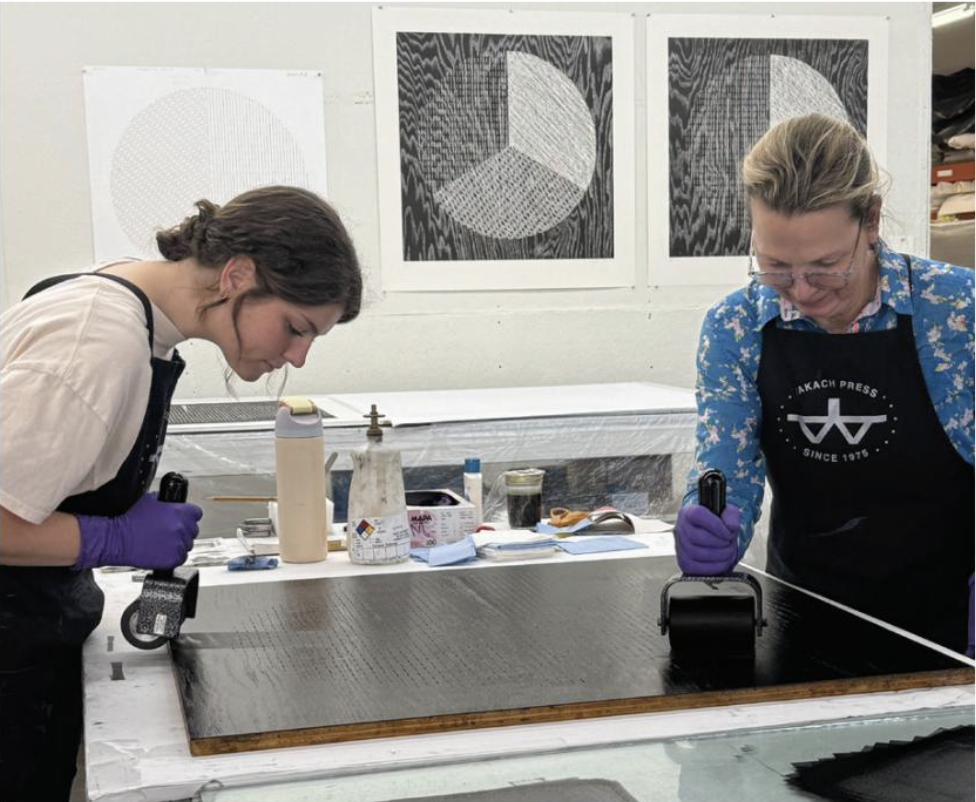
Printer Bekah Farnham and Master Printer Jill Lerner inking woodblock for Pie Charts in the lithograph studio at Gemini. Photo © 2026 Suzanne Felsen
Computer Fan (Woodcut) was inspired by Analia’s time spent studying a collection of German Expressionist woodcuts. She was drawn to the immediacy of the block-printing process, the physical presence of wood grain, and the stark impact of black-and-white imagery.
Analia provided a vector illustration of a computer fan, a technological motif that recurs throughout her practice. Early color proofs were created by laser-cutting and engraving matrices, directly translating the digital image into a physical block. A single composite block was constructed by cutting individual elements from various woods and assembling them like a jigsaw puzzle, in a process reminiscent of veneer marquetry. The assembled block was sandblasted to accentuate the highs and lows of the wood grain, then returned to the laser for engraving of the linework.
Proofing presented a new challenge: some wood grains printed most effectively with heavy inking, others with a lighter touch. To resolve this, multiple proofs were scanned and digitally compiled into a single image, with each element represented at its optimal tonal balance. This composite was then re-engraved into a unified block, producing a consistent matrix for edition printing.
Although I was involved in its development, the edition was printed by Jill Lerner and Megan Anderson.
Jeff McMane
Master Printer
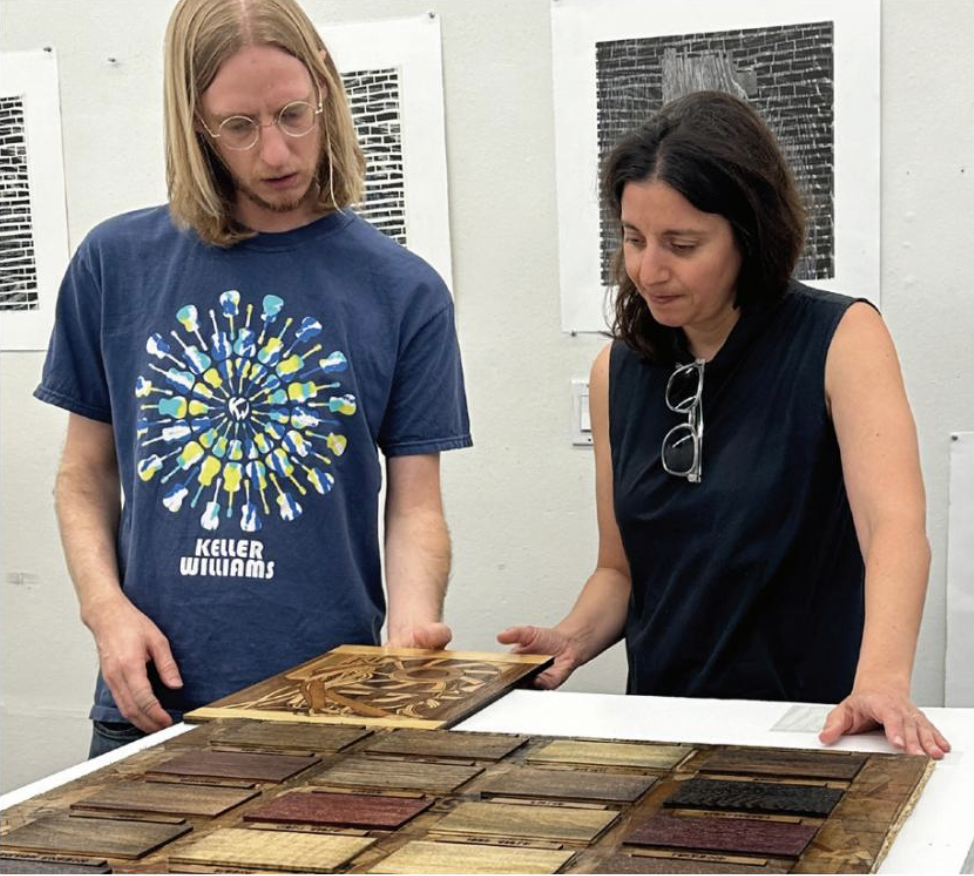
Analia Saban with Master Printer Jeff McMane looking at wood samples for Computer Fan (Woodcut) Photo © 2026 Suzanne Felsen

-
![]() Analia Saban Pie Chart (11%, 14%, 19%, 6%, 11%, 7%, 16%, 16%), 2026 (AS24-1694) 1 color woodcut 42" x 41" (106.68 x 104.14 cm) Edition of 32$3,800
Analia Saban Pie Chart (11%, 14%, 19%, 6%, 11%, 7%, 16%, 16%), 2026 (AS24-1694) 1 color woodcut 42" x 41" (106.68 x 104.14 cm) Edition of 32$3,800 -
![]() Analia Saban Pie Chart (3%, 8%, 11%, 11%, 67%), 2026 (AS24-1695) 1 color woodcut 42" x 41" (106.68 x 104.14 cm) Edition of 32$3,800
Analia Saban Pie Chart (3%, 8%, 11%, 11%, 67%), 2026 (AS24-1695) 1 color woodcut 42" x 41" (106.68 x 104.14 cm) Edition of 32$3,800 -
![]() Analia Saban Pie Chart (33.3%, 33.3%, 33.3%), 2026 (AS24-1697) 1 color woodcut 42" x 41" (106.68 x 104.14 cm) Edition of 32$3,800
Analia Saban Pie Chart (33.3%, 33.3%, 33.3%), 2026 (AS24-1697) 1 color woodcut 42" x 41" (106.68 x 104.14 cm) Edition of 32$3,800 -
![]() Analia Saban Pie Chart (1%, 99%), 2026 (AS24-1698) 1 color woodcut 42" x 41" (106.68 x 104.14 cm) Edition of 32$3,800
Analia Saban Pie Chart (1%, 99%), 2026 (AS24-1698) 1 color woodcut 42" x 41" (106.68 x 104.14 cm) Edition of 32$3,800 -
![]() Analia Saban Pie Chart (40%, 60%), 2026 (AS24-1696) 1 color woodcut 42" x 41" (106.68 x 104.14 cm) Edition of 32$3,800
Analia Saban Pie Chart (40%, 60%), 2026 (AS24-1696) 1 color woodcut 42" x 41" (106.68 x 104.14 cm) Edition of 32$3,800 -
![]() Analia Saban E-Trash, 2026 (AS26-1699) 13-color lithograph 48" x 41 7/8" (121.92 x 106.36 cm) Edition of 42$5,500
Analia Saban E-Trash, 2026 (AS26-1699) 13-color lithograph 48" x 41 7/8" (121.92 x 106.36 cm) Edition of 42$5,500 -
![]() Analia Saban Computer Fan (Woodcut), 2026 (AS23-1693) 1-color woodcut, framed 24 1/4" x 19 1/4" (61.60 x 48.90 cm) Edition of 30$2,800
Analia Saban Computer Fan (Woodcut), 2026 (AS23-1693) 1-color woodcut, framed 24 1/4" x 19 1/4" (61.60 x 48.90 cm) Edition of 30$2,800